Cadenhead’s Small Batch Burnside 1989 26 Years Old

What it is

This Burnside from Cadenheads was distilled in 1989 and bottled in 2015 from ex-bourbon barrels which produced 282 bottles.

Burnside is was it is called “teaspooned” Balvenie.  Balvenie is used in a lot of blends out there (or has been) which are not owned by William Grants its parent company.  Wm Grants sell the whisky on for blending but they “contaminate” each cask with a dash of another single malt.  In this case it is usually Glenfiddich.  The cask therefore has the predominant characteristics of Balvenie for blending purposes but can never be sold on as Balvenie single malt and bottled as such which is something Wm Grants never want to happen.

When you get hold of an expression of a teaspooned cask it is always fascinating to see how much it resembles the supposed prominent malt.  In this case Balvenie.  My theory goes that in essence it must be Balvenie otherwise the blenders would not buy it.  But how true is that?

Interesting fact – Burnside cannot be bottled by anyone, including Balvenie, except for Springbank (actually J&A Mitchell) and hence Cadenhead’s.  William Grants do not own the rights to bottle a whisky under the name Burnside.  They can sell in it bulk under that name but not in a bottle.  Strange eh?

Tasting Notes

Nose:   Lime and aniseed. Sherbet dabs.  Limoncello. Grapefruit and freshly picked cape gooseberries.  Underpinned by wood resin.

Taste:  Sweet.  Peppery.  Candid peel and more sherbet.  Wisp of maple wood smoke.  Tart fruit salad and more gooseberries becoming tangerines with all spice.

Conclusion

This was a good whisky but in essence we felt it was more teaspooned Glenfiddich in characteristic than teaspooned Balvenie.  Interesting.  But how many of us have tried 26 year old Balvenie from an ex-Bourbon cask particularly at this price.

For more information see The Whisky Shop Dufftown.
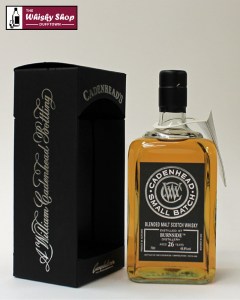
Small Batch Burnside 1989 26 Years Old

Dietary Difficulties

If you work in any capacity in the food industry particularly where food is served to the public this is a bit of a plea.  When some explains that they have a dietary requirement please take it seriously.  It may be a personal choice to follow that diet or it may even be a medical issue.  Either way do not guess, do not lie, please check and be sure.

I have recently become allergic to all dairy products in a big and quite dangerous way.  The effects of eating just a small amount is awful.  No cheese, milk, butter, cream, chocolate, pizza, pesto…  The list is long and contains so many of my previous staples in my diet.  You probably would have guessed most of those but it is actually much worse.

This is not the same as Lactose intolerance.  That is a common misunderstanding.  There are many more proteins in dairy that you can be intolerant or allergic to.  It is much more complicated than just Lactose.  There is also Whey, Caseinate and Rennet to name but a few.  However, the most common to be found in foods is Lactose and Whey.

Lactose creeps its insiduouse way in to all sorts of products many you would not expect.  Don’t think this is a thing about adding milk to something.  Some salt and vinegar flavoured crisps contain Lactose.  Would you have thought of that?  So do many breads.  It is also used as a packing agent in most tablets.  I take medication for another condition and sourcing tablets that do not contain Lactose has been a big problem.  Come on, would you really have guessed that most tablet based medicines contain milk?

Whey is only slightly better and seems to be an ingredient that is added to food for the lack of creativity to identify something else to put in.  Is there some kind of whey mountain that a secret organisation is attempting to get rid of my sneaking it into our food?

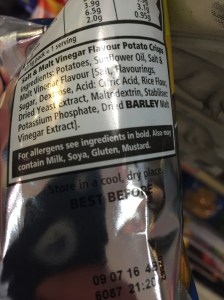
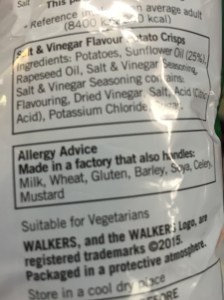
Here is a favourite phrase that appears on many food packets.  “Produced in a factory where milk is also used.”  This has become very popular recently and is springing up all over the place meaning I have to check and re-check everything I buy and the items in my food cupboard dwindle again.  It’s like my food is being picked off one by one in some freaky horror movie.  I do wonder what this phrase means.  We cannot guarantee that we have not accidentally chucked in some milk to the next batch of TUC biscuits even though the recipe does not call for it.  When that does happen we don’t trash the batch we think what the hell and send it out in to the world.  Alternatively does it mean that we don’t wash the equipment in our factory when we have made something that contains milk and then move on to something that doesn’t?  Every batch of product X contains a bit of product Y just for fun.  I know this is probably some kind of legal precaution but seriously.  My wife does not suffer from the same condition and we are able to keep milk in the fridge without it sending out wispy tentacles of contamination into everything else in then fridge.  So please why?  Also, why is this phrase frequently on a different part of the packaging to the ingredients meaning you have to continually turn over and over a product to ensure you  have read everything including the bit that is tucked away in the fold of the wrapper.

May also contain...

May also contain…

Made in a factory...

Made in a factory…

I understand this is a hassle when taking my order in the restaurant or stand in front of the product you want in the supermarket while I examine the very small print list of ingredients but it is a much bigger hassle for me.  Trust me.  I am embarrassed to go through it every time I eat something I have not prepared myself.  Please bare with me and help ensure I do not get ill!


Letting Search Engines See “Out of Stock” Products

I have been buying whisky on the web probably for as long as you have been able to.  Not so much these days obviously.  I have always been annoyed when you are searching for a whisky and you enter its name into the Google search box and it comes back with 5 results that when you click on each one you go to a page which says the whisky is Sold Out.  My time has been wasted.  Actually this really annoys me.

The Whisky Shop Dufftown is now on its third website (actually we are working on 3.2) and each time I developed one I have paid extra to have an automatic routine that runs each night and hides our out of stock products from search engines.  I think this is being fair to my customers.  I don not want to waste their time but am I being an idiot?

Why do other companies allow their out of stock products to be indexed by search engines?  The most practical reason is you have to pay extra development costs to have this done.  I have not come across any e-commerce shop where there is a global switch to hide out of stock products.  In reality the cost of doing this is minuscule to what we have to pay for our websites so there must be another reason.

From developers and the owners / runners of other websites I have been told some other reasons.  Firstly, if you click through to an Out of Stock product you might just stay on the website and buy something else.  I am told that if only 1 person in a 100 does this it’s worthwhile doing.  Secondly, just having the click through helps with your Google ranking etc.  But is all of that worth wasting the time for the other 99 customers or am I missing out on that 1 sale?WSD SOLD OUT

Over night another issue with my strategy has come to light.  A customer thought that as he could not find a fast selling / rare product on my website that I had not stocked it and therefore he assumed that I actually do not ever stock rare or fast selling whiskies.  If this is a general view created by my strategy then this could be a real problem.

This practice of continuing to list out of stock products is almost universal now so is it now the expectation of customers that they have to click through multiple search hits to actually find a site where the whisky they want is still listed? Are you as a whisky buyer now numb to this time wasting?